
Supplier Product Data & Feed Normalization

Turn supplier product data into usable catalog files

We assess supplier CSV files, agree field mappings and normalize supported attributes — protecting critical identifiers and checking the output before handoff.

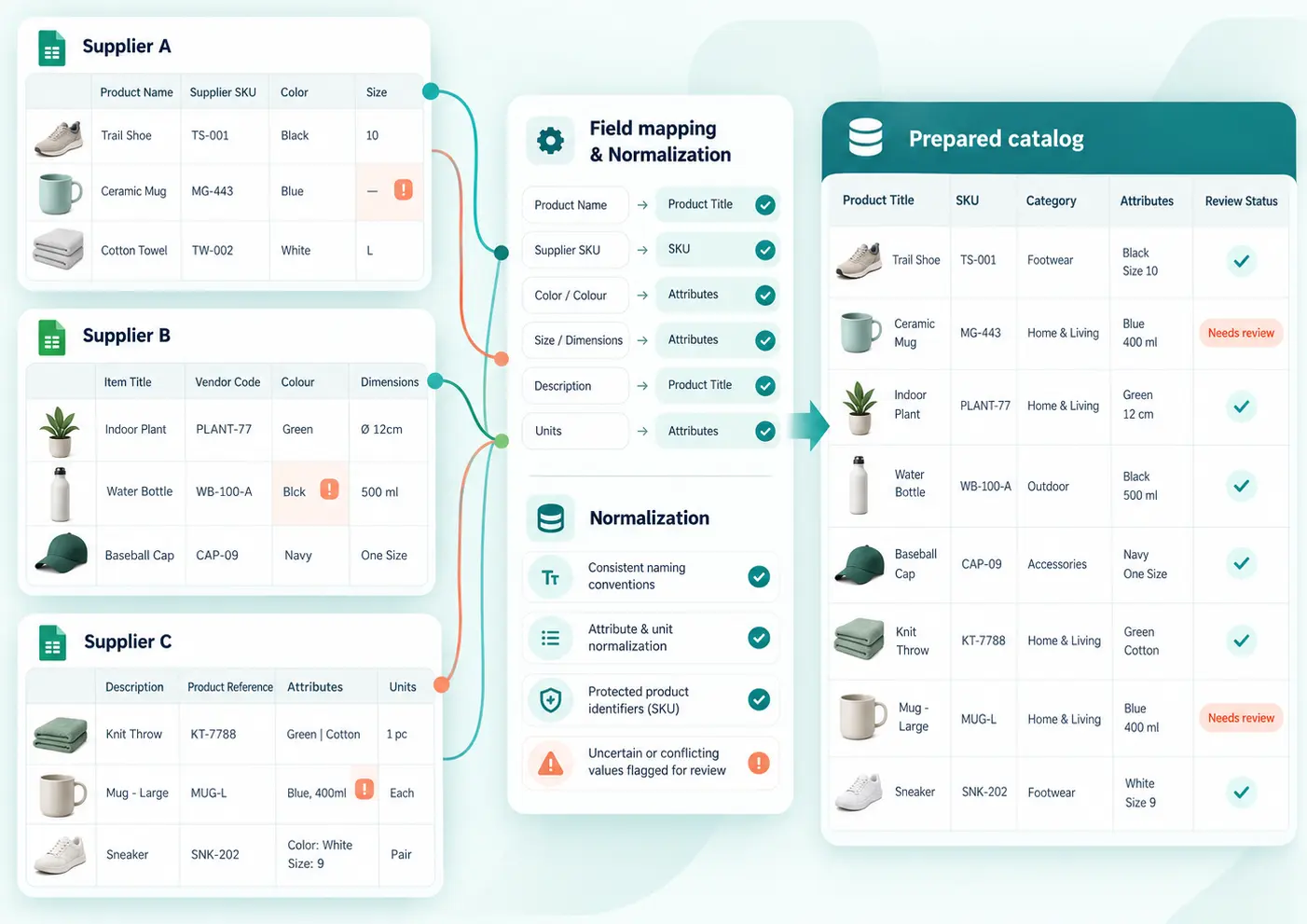
Illustration showing supplier product files with different column structures mapped and normalized into a consistent ecommerce catalog, with uncertain records flagged for review.

Recognize the source problem

Why supplier product files need preparation

Different column names

Useful fields arrive under supplier-specific names that need an agreed destination.

Inconsistent attributes

Units, terminology and formatting vary between files and product ranges.

Missing or conflicting facts

Gaps and disagreements need review, not unsupported guesses.

Incompatible records

Duplicate rows and inconsistent product structures complicate a direct import.

For merchants, distributors and agencies onboarding suppliers or preparing new product ranges.

Defined transformations

Standardize supplier fields — without inventing product facts

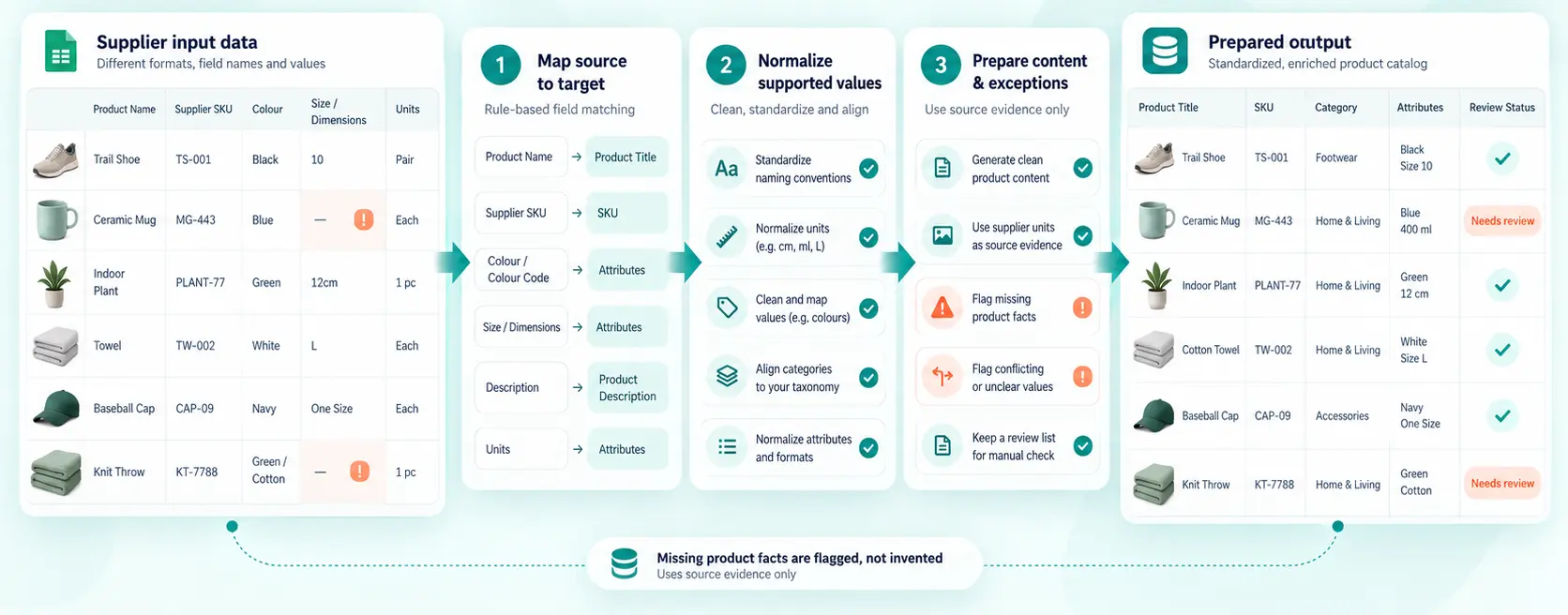
Illustration showing supplier product data being mapped, normalized, and prepared into a structured catalog output, with unclear or conflicting values flagged for review rather than invented.

Normalization follows the available source evidence. It does not create missing product facts.

A controlled boundary

Normalize supported fields — protect critical values

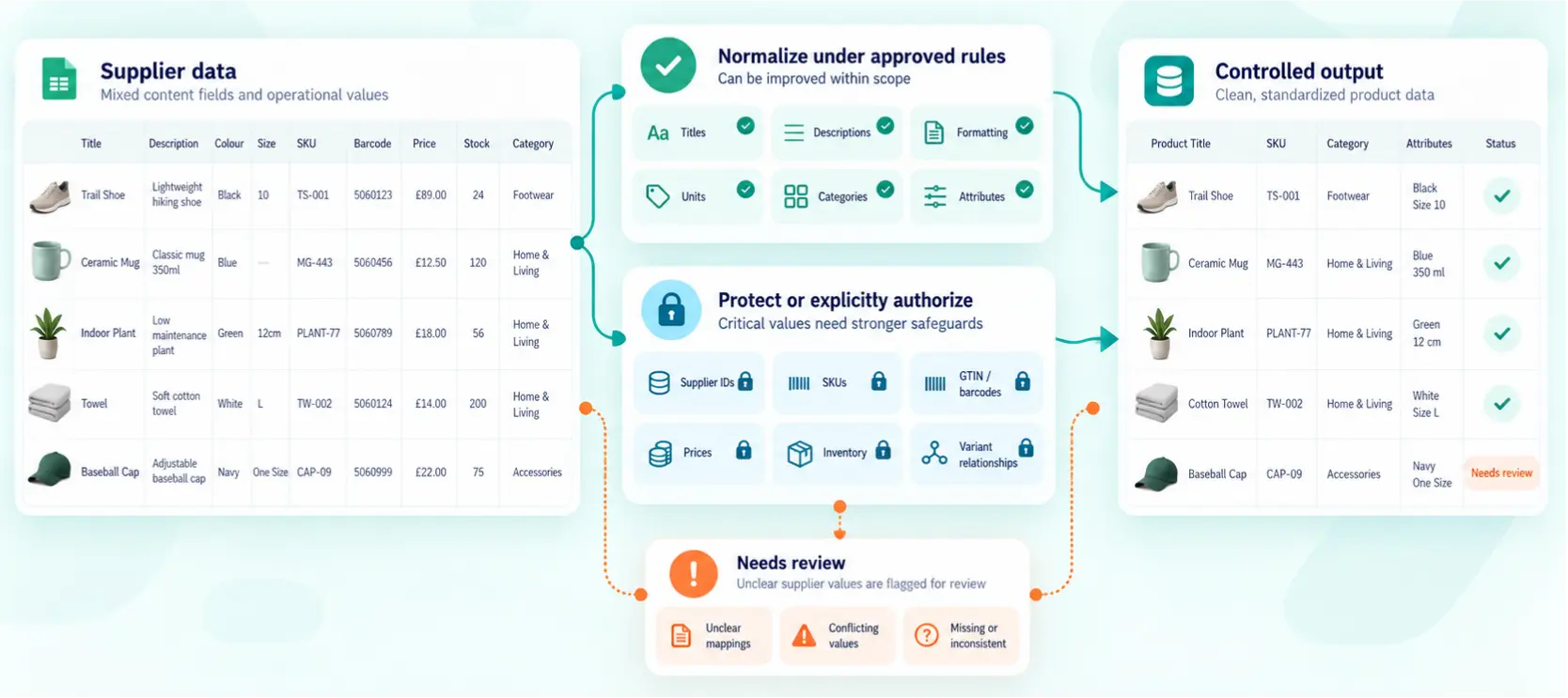
Illustration showing supplier product data split into two paths: supported fields that can be normalized and critical operational values that are protected or require explicit approval, with unclear values flagged for review.

Mapping uncertainties and conflicting supplier values are flagged for human review. A supplier’s value is never chosen silently without approved rules.

A documented handoff

What you receive after supplier data normalization

Prepared product file

Normalized data for the agreed workflow, with supported output requirements confirmed.

Mapping and change notes

Documented field choices, changes, limitations and handoff information.

QA and review findings

Agreed checks, unresolved exceptions and a needs-review file where required.

Deliverables reflect the agreed project scope. Unresolved issues remain documented for review before the prepared data is used.

Scope & pricing

What affects supplier data normalization pricing?

We assess your requirements and confirm the supported work, output and project-specific quote before processing begins.

What shapes the work

Our standard service focuses on file-based preparation. Recurring feed automation and live integrations are not included; additional requirements can be assessed separately.

Practical questions

Before we scope your supplier files

Select a question to expand its answer.

What supplier file formats can you assess?

Start with a supplier CSV or a representative product-file sample. Unusual formats are assessed through the Catalog Diagnostic; support is confirmed only after reviewing the structure and intended output.

Can you work with files from several suppliers?

Yes, where supported and agreed in scope. We assess each source and define shared field meanings and mapping rules before combining or normalizing values.

What happens when supplier information conflicts?

Conflicting values are flagged for review. We do not silently choose one supplier’s value without an approved rule, and missing product facts are not invented.

Will SKUs or supplier identifiers be changed?

They are protected by default, alongside agreed GTINs, prices, inventory values and product-to-variant relationships. Any authorized change requires explicit agreement and appropriate checks.

Can you prepare files for Shopify or another platform?

Where supported, we prepare output for an agreed ecommerce destination. Compatibility depends on source structure, field mapping and project scope; the destination workflow still needs appropriate review before import.

Is recurring feed synchronization included?

No. The standard service is scoped, file-based preparation. Recurring feed synchronization, live APIs, ERP/PIM integrations and real-time inventory updates are outside the standard scope.

How are scope and pricing determined?

We review your requirements and a representative source, assess mapping complexity and review needs, then confirm a project-specific scope and quote before work begins.

Start with the problem

Ready to prepare your supplier files?

Tell us about your supplier files and the output you need through the Catalog Diagnostic. We’ll confirm what sample information is useful, then outline a practical scope and quote.

Asynchronous communication. Project-specific scope. No immediate upload or mandatory call.